
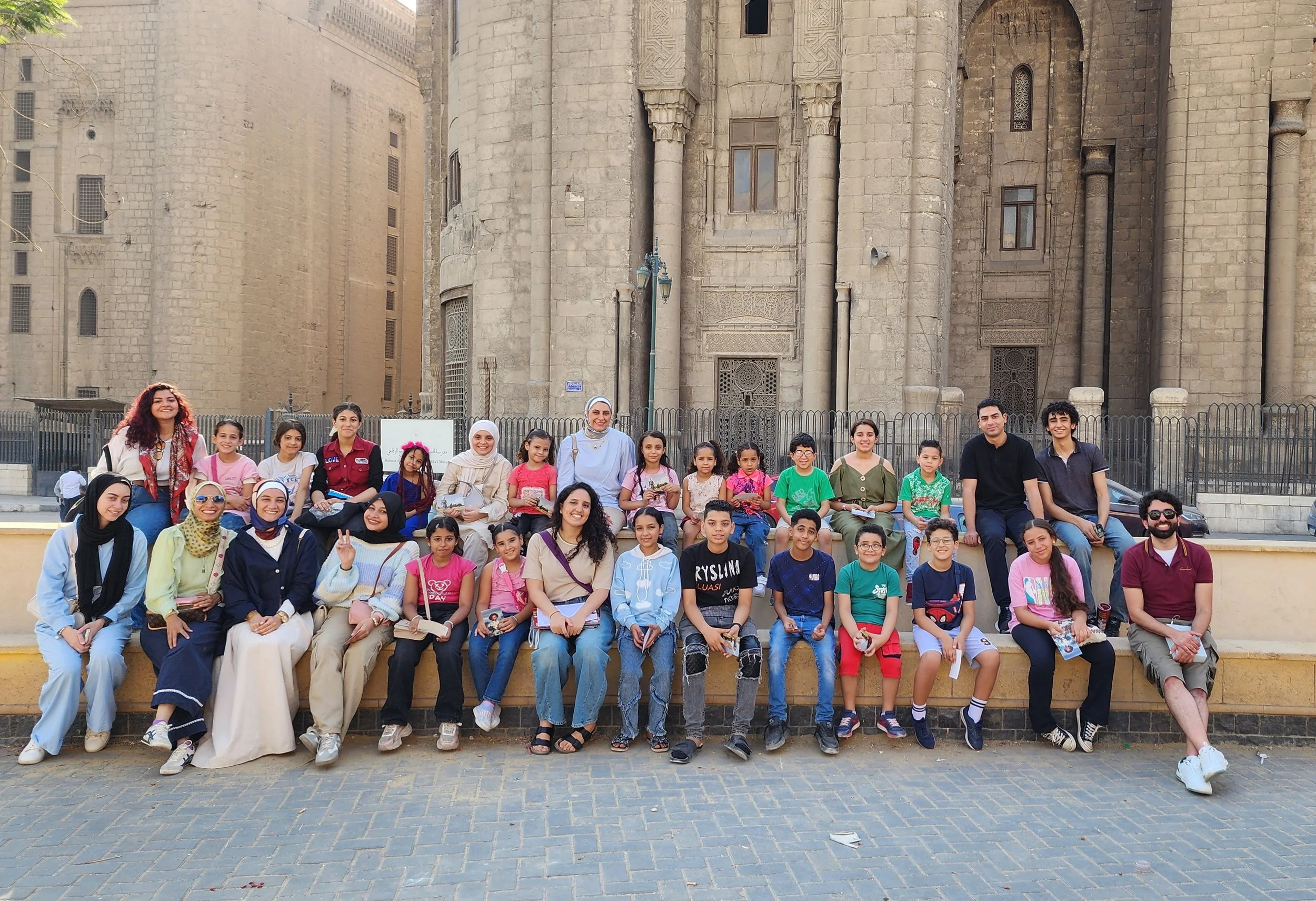
Once upon a time in Cairo, the capital of Egypt, fate paved the way for an architect and educator to witness the insightful adventures of children exploring the built environment at an early age. Through careful observation, it became evident that children’s narratives about architecture possess a distinctive and profound quality; one that often goes unnoticed unless adults intentionally pause to listen.
These tales were nurtured under the umbrella of Arch.Kids.Lab, a self-initiated platform dedicated to introducing children and youth to the built environment. What began as a dream gradually evolved into a tangible initiative, further empowered by receiving the Commendation International Award for Engagement 2024 from the Inspire Future Generations Award, granted by the Thornton Education Trust.
Arch.Kids.Lab was founded in 2021 following a series of exploratory engagements with children in schools and social hubs. These early endeavors were driven by both social commitment and a deep passion to extend architectural discourse beyond university classrooms. The goal was to communicate the importance of a better built environment to a wider audience, particularly the younger generation.
Launching a new initiative without formal institutional backing presented significant challenges. However, these challenges were self-driven and sustained by enthusiasm, perseverance, and continuous learning inspired by the children’s evolving architectural tales. As the initiative expanded, activities diversified to include extracurricular school programs, workshops at cultural centers, tailored architectural courses during summer and winter breaks, collaborations with charitable foundations to renovate schools with the active participation of children, internships at architectural firms, and various community-based projects.
At Arch.Kids.Lab, our vision has been to create a “Ripple Effect” by including children; defined by UNICEF as individuals under 18 years of age, in diverse forms of architectural activism. This inclusion ranges from learning through STEAM-based curricula to engaging with university environments, experiencing professional practice, and participating in decision-making processes related to implemented projects.
Although this ripple effect continues to expand through growing networks and collaborations, our aspiration remains to reach unprivileged communities and extend our impact further. In Egypt, children constitute approximately 41% of the country’s 110 million population, highlighting both the urgency and the opportunity for such engagement.
Notably, Arch.Kids.Lab has operated without formal funding from any entity. Despite this, the initiative has directly engaged hundreds of children. This experience demonstrates the transformative potential of individual initiative in laying foundations for meaningful change; change that can expand organically, directly or indirectly, and generate sustained impact.
Architectural Tales... Written by Children
By Mennat-Allah El-Husseiny, Professor of Architecture at Cairo University
“It has been remarkably inspiring to witness how complex topics related to the built environment can be simplified and made accessible through interactive engagement. As educators, we are continually rewarded by the threads of stories woven by children, stories that collectively form a powerful and imaginative tapestry.”
The initiative has also embraced inclusivity, opening its doors to children with special needs, marginalized communities, and those from war-affected regions currently residing in Cairo.
Returning to the architectural tales themselves, these narratives have grown in depth and richness alongside the initiative’s development. It has been remarkably inspiring to witness how complex topics related to the built environment can be simplified and made accessible through interactive engagement. As educators, we are continually rewarded by the threads of stories woven by children, stories that collectively form a powerful and imaginative tapestry.
From reflections on historical cities to explorations of sustainability, children consistently exceed expectations. Their analytical narratives and creative compositions demonstrate not only imagination but also critical thinking and ownership. Through their tales, they frame dreams for a present and a future that they rightfully claim as their own.
Although this ripple effect continues to expand through growing networks and collaborations, our aspiration remains to reach unprivileged communities and extend our impact further. In Egypt, children constitute approximately 41% of the country’s 110 million population, highlighting both the urgency and the opportunity for such engagement.
Notably, Arch.Kids.Lab has operated without formal funding from any entity. Despite this, the initiative has directly engaged hundreds of children. This experience demonstrates the transformative potential of individual initiative in laying foundations for meaningful change; change that can expand organically, directly or indirectly, and generate sustained impact.
The initiative has also embraced inclusivity, opening its doors to children with special needs, marginalized communities, and those from war-affected regions currently residing in Cairo.
Returning to the architectural tales themselves, these narratives have grown in depth and richness alongside the initiative’s development. It has been remarkably inspiring to witness how complex topics related to the built environment can be simplified and made accessible through interactive engagement. As educators, we are continually rewarded by the threads of stories woven by children, stories that collectively form a powerful and imaginative tapestry.
From reflections on historical cities to explorations of sustainability, children consistently exceed expectations. Their analytical narratives and creative compositions demonstrate not only imagination but also critical thinking and ownership. Through their tales, they frame dreams for a present and a future that they rightfully claim as their own.