
The redevelopment of Camley Street in Camden will create a new neighbourhood with homes, commercial space and open, public space. Its location demanded that it was permeable, stitched into existing communities and with new routes linking to Camden Town and Kings Cross.
A key project for Camden Council’s Community Investment Programme (CIP), our team (Ballymore with Lateral) was selected as the private sector partner to bring this scheme forward in late 2024. The CIP team had been engaging on the future of the site since 2020, so our task was not to revisit what had been done, but to build on this work and undertake meaningful pre-planning activity.
The team agreed that young people were a vital focus (as a group who tend to be left out of engagement and regeneration) and, alongside a host of other youth-focused engagement, we commissioned Social Place and In Her Place to devise and work with us to deliver the Camley Street Young Researchers in Residence programme.
This was an eight-week paid working and learning experience that offered seven young women and nonbinary people, aged 17–25, a learning opportunity and a chance to influence the emerging designs for Camley Street through inclusive, youth-led research. It focused on equipping the participants with the skills, confidence, and platform to investigate their own experiences of public space, with a focus on their gendered experiences of safety, in order to develop practical proposals.
The Young Researchers followed a curriculum of readings, lectures, and activities covering key social scientific, planning, and design themes. This gave them training in social scientific, visual, and spatial research methods, which they then applied to explore their experiences of Camley Street. Activities included:
• Safety mapping and walking audits of the local area;
• Observation, photography and filmmaking to highlight barriers and their experiences;
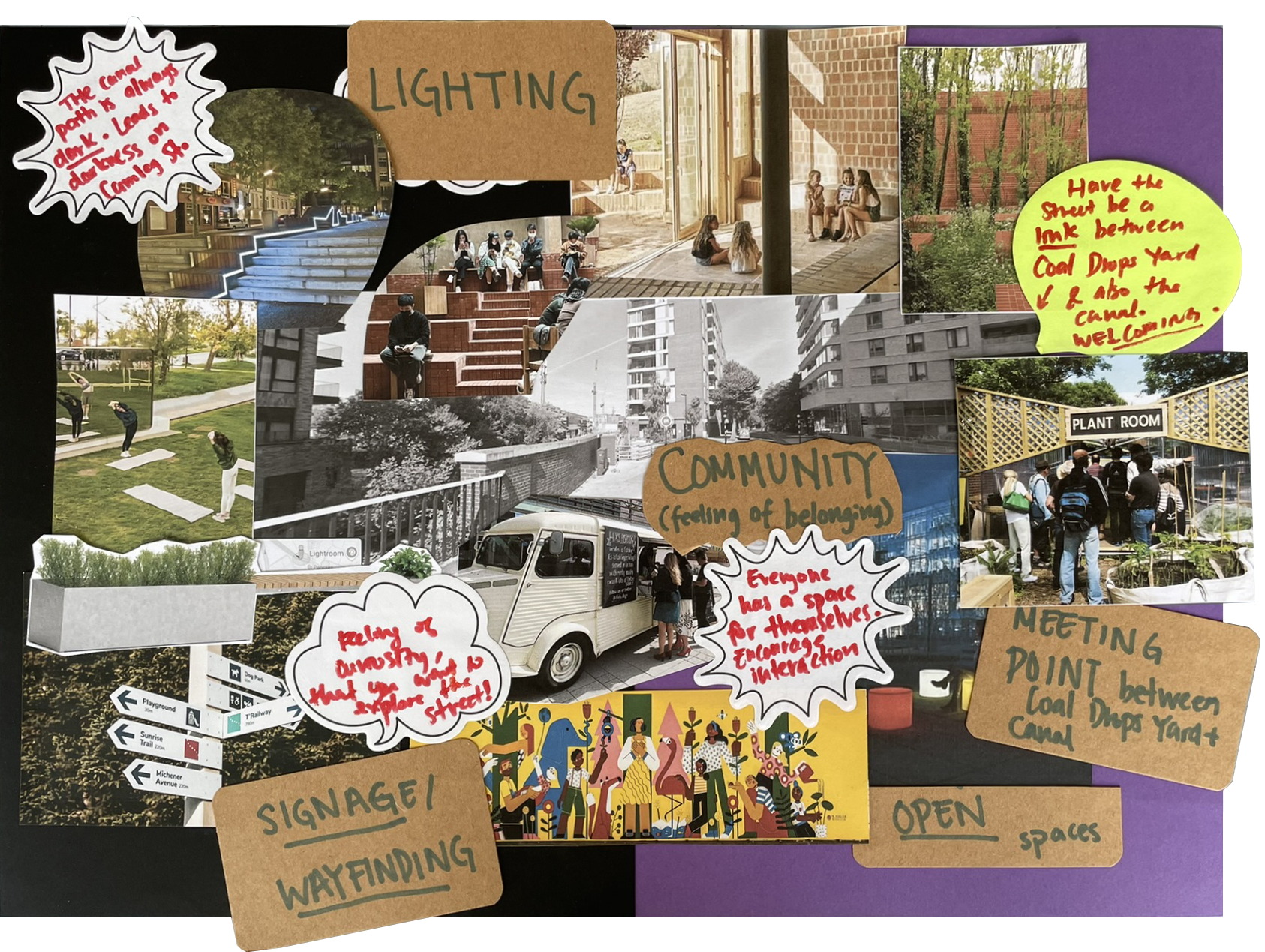
• Creative writing, drawing, and collage to develop design ideas;
• Manifesto making to communicate key insights and priorities;
• Presenting their work to the client team, wider local authority teams and architects to influence change.
Embedding young voices in regeneration: the Young Researchers programme at Camley Street
By Jennifer Ball, Engagement Lead, Ballymore Group
“As a client team we learnt a lot from this programme which furthered our understanding of the value of genuine youth feedback. The young people who participated in this, and other programmes, showed huge care and passion for the future of their locality, but we as an industry need to make sure we understand how to get them involved. ”
The findings of the group were grouped under four headings: safety and comfort; identity; connectivity and use; and inequalities. A host of specific challenges were identified under each of these – from narrow pavements and blind spots to poor existing wayfinding and a fear of loss of the area’s diversity and identity.
Taking these forward the Young Researchers proposed a series of interventions such as inclusive spaces that encourage activity throughout the day and evening, involving the community in the care and upkeep, and local artists to safeguard the area's heritage. Nature, accessibility and playfulness all came through and the overriding theme was the desire of the young people to be part of the community that establishes Camley Street as a successful, sustainable new neighbourhood.
As a client team we learnt a lot from this programme which furthered our understanding of the value of genuine youth feedback. The young people who participated in this, and other programmes, showed huge care and passion for the future of their locality, but we as an industry need to make sure we understand how to get them involved. In the case of the Young Researchers, offering payment demonstrated that their time was valuable and carefully designing a programme that enhanced their skills ensured the engagement was mutually beneficial, not a “one way street”. We will be taking these learnings through to later stages of Camley Street, and other ongoing Ballymore schemes. Integrating skills development and confidence building with consultation has been immensely valuable.
The impact didn’t stop at the end of the programme. We are still in contact with the group and are delighted that one of the cohort is exploring a masters in film as a result of experimenting with film making as part of the programme, whilst another is now in an engagement apprenticeship at the Francis Crick Institute - and spoke in support of the scheme at the planning committee. We couldn’t have wished for a better outcome for everyone.